Kentucky Motorcycle Insurance Requirements and Liability Explained
Kentucky law requires motorcyclists to carry insurance coverage, and failing to do so can lead to serious legal and financial consequences. In this post, we break down Kentucky’s motorcycle insurance requirements, minimum coverage limits, penalties for riding uninsured, and how insurance (or lack thereof) affects accident liability. We also cover key differences between motorcycle and car insurance in Kentucky, plus optional coverages that can better protect you on the road.
Do You Need Motorcycle Insurance in Kentucky?
Yes, Kentucky requires all motorcyclists to have liability insurance on their bikes. Just like drivers of cars, motorcycle owners may not operate the vehicle without first obtaining insurance. Kentucky’s mandatory insurance law is intended to protect all road users by ensuring that anyone who causes an accident has the financial ability (through insurance) to cover others’ damages. Riding without insurance isn’t just risky, it’s illegal. According to state statute, an owner who fails to maintain insurance will have their motorcycle registration revoked, and both the owner and driver can face misdemeanor penalties.
Why Is Motorcycle Insurance Mandatory?
Liability insurance isn’t just a bureaucratic requirement, it’s a financial safeguard for both the rider and others on the road. Without it, a single accident can lead to thousands of dollars in damages and potential lawsuits. Insurance helps ensure that accident victims can recover costs for medical care or property damage, and it protects the rider from devastating out-of-pocket expenses.
Legal penalties for riding without insurance in Kentucky are severe. For a first offense, you can be fined $500 to $1,000 and even jailed up to 90 days, and the state will suspend your vehicle registration and license plates for one year (or until you show proof of insurance). The court may allow a conditional discharge (reducing the penalty) if you obtain insurance and provide proof quickly, but there’s no guarantee. Repeat offenses within 5 years carry even harsher consequences: fines increase to $1,000–$2,500, jail up to 180 days, and longer suspensions (possibly up to 2 years) of your registration and even your driver’s license. In addition, before your driving privileges are reinstated you’ll have to pay a reinstatement fee and provide proof of current insurance. Simply put, Kentucky will not tolerate uninsured vehicles on the road.
Tip: Kentucky actively monitors vehicle insurance status. If you cancel your motorcycle’s insurance while the registration is active, the state’s system will flag it. The Transportation Cabinet sends notices warning owners to obtain insurance or face registration cancellation. For seasonal riders who park their bikes in winter, do not drop coverage without turning in your plates. If you won’t maintain insurance year-round, you must surrender the tag to the County Clerk before canceling your policy to avoid penalties. When you’re ready to ride again, you can re-register by providing proof of new insurance.
You can find additional information about these penalties by visiting the Kentucky Transportation Cabinet
Minimum Liability Coverage Requirements (25/50/25 Limits)
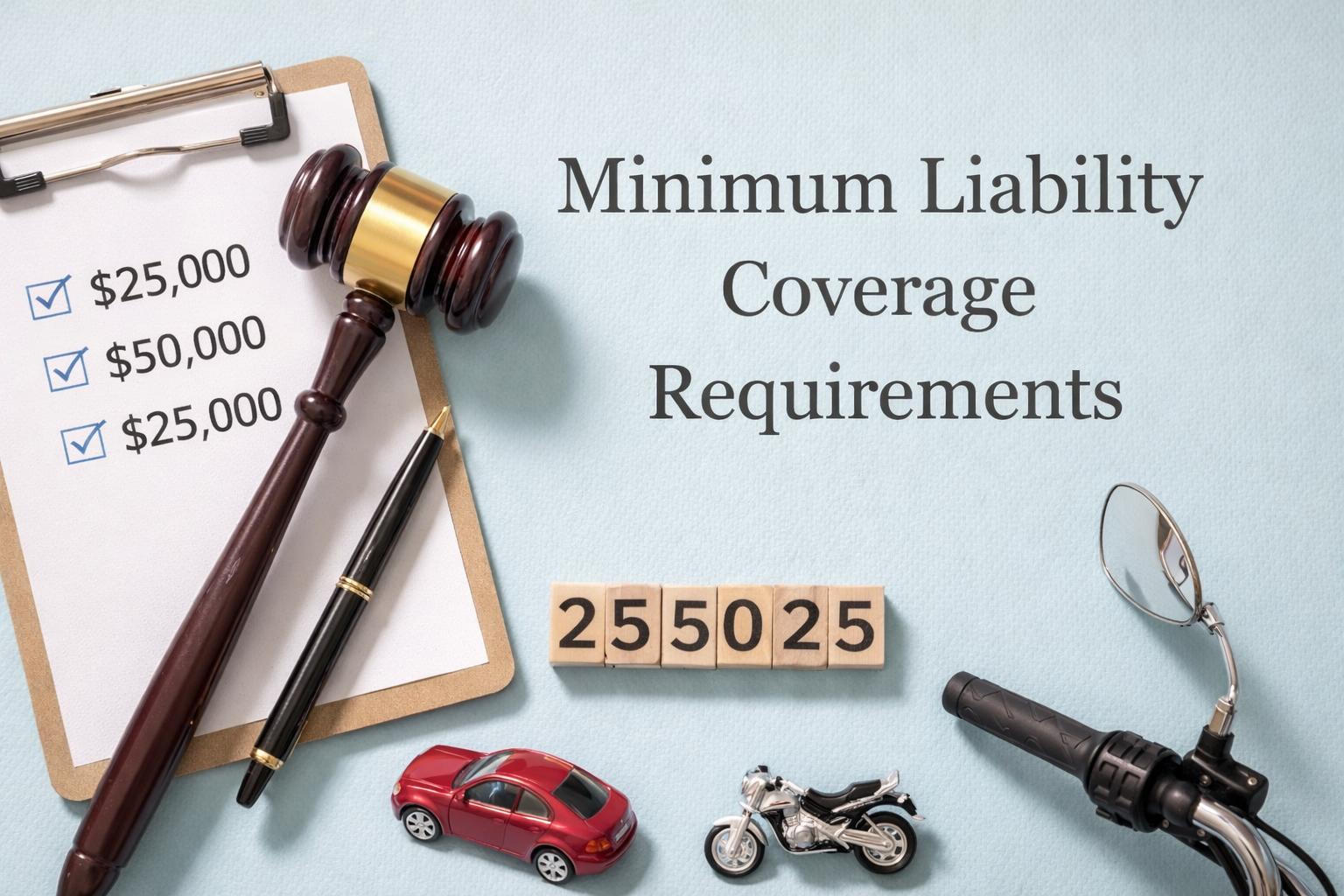
To legally operate a motorcycle in Kentucky, you must carry at least the minimum liability insurance limits set by state law. Kentucky follows a “25/50/25” rule for minimum coverage:
- $25,000 in bodily injury liability per person (for injuries you cause to one other person in an accident).
- $50,000 in total bodily injury liability per accident (the maximum your insurer will pay for all injuries to multiple people in one accident).
- $25,000 in property damage liability per accident (for damage you cause to someone else’s vehicle or property).
These are the same minimum limits required for cars and trucks in Kentucky. In lieu of the split limits above, Kentucky also allows a single combined liability limit of $60,000 for all injury and property damage claims from one accident. In other words, you can meet the requirement with a policy that has a $60,000 “single limit”, which covers all damages collectively, instead of separate per-person and per-accident limits
Keep in mind these are only minimums. In a serious motorcycle accident, $25,000 per person may not go far – hospital bills and surgeries can quickly exceed this amount. Kentucky’s required minimums haven’t changed since 1974 and are “not enough coverage” for many accidents. You can (and probably should) purchase higher liability limits to better protect your personal assets if you cause an accident.
Basic Personal Injury Protection (PIP) coverage, which is a form of no-fault insurance providing up to $10,000 for your own injury expenses, is mandatory for most motor vehicles in Kentucky – but not for motorcycles. We’ll discuss this important difference in the next section. Just remember that even though motorcycles are exempt from PIP, liability insurance is absolutely required. You must show proof of insurance when registering your motorcycle, and Kentucky will only accept policies from licensed (admitted) insurers – you cannot use an out-of-state or surplus lines insurer to meet the requirement for registration.
Motorcycle Insurance vs. Car Insurance: No-Fault Rules and PIP Exemption
Kentucky is a “no-fault” insurance state for most automobiles. This means car owners must carry Personal Injury Protection (PIP) coverage (also known as “basic reparation benefits”) of at least $10,000, and in the event of an accident each driver’s own PIP pays for their medical bills and lost wages regardless of who was at fault. Kentucky’s no-fault law also limits the right to sue: an injured person cannot pursue the at-fault driver for pain-and-suffering or other damages unless their injuries exceed certain thresholds (such as over $1,000 in medical bills, a broken bone, permanent injury or disfigurement, or death). However, motorcycles are treated differently. Kentucky law exempts motorcycles from the mandatory PIP requirement
In practical terms, this means if you’re a motorcyclist, you are not required to carry PIP coverage on your bike (and many insurers don’t include it unless you add it). But it also means you won’t automatically have no-fault benefits to cover your injuries if you’re hurt in a crash. For example, if a car driver runs a red light and hits your motorcycle, that driver’s PIP would cover their own initial medical expenses, but you as a motorcyclist would not have any PIP to cover your hospital bills by default. You would need to seek compensation from the at-fault driver’s liability insurance or file a lawsuit for your injuries. In Kentucky, drivers can opt out of the no-fault system by filing a form, but motorcyclists are essentially outside no-fault by default (unless they choose to purchase optional PIP).
Important: Even though motorcyclists don’t have to carry PIP, if you do not carry PIP on your motorcycle, Kentucky law still holds you to certain no-fault limitations. Unless you formally rejected no-fault in writing with the Department of Insurance, you are presumed to have accepted the tort limitations. According to the Kentucky Department of Insurance, if a motorcycle owner elects not to buy PIP coverage (and doesn’t file a no-fault rejection), they “will be unable to recover the first $10,000 of a motorcycle injury claim from the at-fault party. In other words, the law penalizes uninsured riders by barring recovery of up to $10,000 in damages that would have been covered by basic PIP. This effectively serves as a “no pay, no play” rule – if you didn’t pay for PIP coverage, you don’t get to collect the first $10k of your losses from someone else. Even if another driver 100% caused the wreck, you could be left paying your own medical costs up to $10,000 out-of-pocket because you had no PIP. Additionally, because you are deemed to have accepted Kentucky’s no-fault limitations, you might be barred from recovering certain non-economic damages (like pain and suffering) if you were uninsured at the time of the accident.
This aspect is complicated, but the takeaway is that not having PIP can put an injured motorcyclist at a disadvantage when seeking compensation, even when the other driver was at fault. You can avoid this problem in one of two ways:
- Purchase optional PIP coverage for your motorcycle. While not required, you can usually add basic PIP or similar “med pay” coverage to a motorcycle policy (the insurer may charge extra given the higher risk). This ensures you have up to $10k for your own injuries regardless of fault, and it means you’re not forfeiting those first-dollar damages in a claim. Given how vulnerable riders are, many attorneys “recommend [PIP] considering how dangerous riding a motorcycle can be.”
- Formally reject no-fault limitations by filing a Rejection Form (Kentucky Department of Insurance form) and paying a small fee. This opts you out of the no-fault system entirely. If you do this, you won’t have PIP (and can’t claim PIP from anyone), but you also preserve the right to sue an at-fault driver for all your damages without the $10k penalty or injury thresholds. Be aware, though: rejecting no-fault also means others can sue you without injury thresholds if you cause an accident. This can slightly increase your liability exposure and insurance premiums.
Most Kentucky motorcyclists simply go without PIP and do not file rejections (often not realizing the consequences). If that’s the case, just understand that if you’re injured by someone else, the first $10,000 of your economic losses may not be recoverable and you’ll need to clear the tort threshold to claim pain and suffering. It’s a trade-off of Kentucky’s system. On the flip side, because motorcycles aren’t covered by no-fault, a motorcyclist is free to sue an at-fault driver for property damage and other losses immediately – you don’t have to meet the thresholds that apply to cars for suing over injuries.
Finally, aside from PIP, motorcycle insurance policies function the same as auto insurance in terms of liability coverage. Your liability insurance will cover injuries or damage you cause to others up to your policy limits. And if another vehicle’s driver injures you, their liability insurance should cover your damages (after you clear any no-fault thresholds or offsets discussed above). Just remember that as a motorcycle owner, you must carry the required liability coverage, even though PIP is optional. Kentucky law makes it clear that only the liability coverages are required for a motorcycle (KRS § 304.39-110(3)), but those liability coverages are the critical part that protects others and keeps you legal on the road.
Uninsured Motorcyclists and Accident Liability
What happens if you get into an accident and you don’t have insurance on your motorcycle? This scenario has two sides: if you’re not at fault for the crash versus if you caused the crash. It’s important to distinguish the impact on accident liability (fault for the crash) from the legal consequences of being uninsured.
- If another driver hits you and you are uninsured: The good news is that not having insurance does not automatically make an accident your fault. Fault is determined by who acted negligently (traffic violations, reckless behavior, etc.), not by who has insurance. So if a car driver was wholly to blame for hitting you, that driver remains liable for the accident even though you were uninsured. You can still pursue a claim against the at-fault driver for your injuries and damage. However, being uninsured will complicate your recovery. You won’t have your own PIP benefits to cover immediate medical bills, so you’ll likely have to pay expenses upfront and then seek reimbursement from the other driver’s insurer or via a lawsuit. This process can be slow and difficult, especially if the at-fault’s insurer disputes liability or the value of your claim. Moreover, as discussed above, Kentucky law may limit the damages you can recover from an at-fault party if you were operating uninsured. In fact, an uninsured injured motorist in Kentucky is barred from recovering the first $10,000 of costs (which would have been covered by PIP) from the other driver. You also may not be able to claim certain non-economic damages (pain, suffering, etc.), depending on the circumstances. Essentially, riding uninsured can put you in a position where you shoulder some of your own losses even when the other person was at fault – a harsh outcome of Kentucky’s no-fault and “no pay, no play” rules.
- If you cause an accident while uninsured: When you are at fault for a crash, your lack of insurance leaves you personally on the hook for all damages. The other party (or their insurer) can pursue you for everything – medical bills, lost wages, vehicle repairs, pain and suffering, etc., up to the full amount of the harm. Normally, your liability insurance would step in to pay these damages on your behalf (up to policy limits) and also provide you a legal defense. But if you have no insurance, you’ll be paying out-of-pocket. The injured parties can file a lawsuit against you, and if they win a judgment, your personal assets and income are at risk – the court could garnish wages or place liens to collect what you owe. In addition, you will still face the criminal/administrative penalties for driving uninsured (fines, license suspensions, etc. as outlined earlier). Many uninsured drivers find themselves in financially ruinous situations after an at-fault accident. The bottom line: one mistake on the road could cost you tens or even hundreds of thousands of dollars if you have no insurance to protect you.
In summary, being uninsured does not determine accident fault, but it greatly affects the aftermath. If you’re not at fault, you may still recover some compensation, but you’ll lose certain benefits and potentially some damages, and you’ll definitely get ticketed for no insurance. If you are at fault, you face full personal liability and legal penalties. This starkly illustrates why carrying insurance is not only required by law but also crucial for your own financial protection.
Optional Coverage to Consider: UM/UIM and More
Meeting Kentucky’s minimum requirements is just the starting point. There are several optional insurance coverages that motorcyclists should strongly consider adding to their policies for better protection:
- Uninsured Motorist (UM) Coverage: This covers you if you are injured by a driver who has no insurance. Despite laws requiring insurance, many drivers are uninsured or hit-and-run. UM coverage pays for your medical bills, lost income, and pain and suffering when an at-fault driver cannot pay. In Kentucky, insurers are required to include UM coverage at the same minimum limits (25/50) in every auto policy by default – the only way it wouldn’t be on your policy is if you reject it in writing. So unless you signed a waiver, your motorcycle insurance likely already has UM coverage equal to $25,000 per person/$50,000 per accident for bodily injury. It’s wise not to reject UM, and in fact you can buy higher UM limits. This coverage is relatively inexpensive for the amount of protection it provides, and it steps into the shoes of the at-fault driver’s liability insurance if they have none. For example, if a negligent driver runs you off the road and they carry no insurance, your UM would pay your injury claim up to your policy’s limits.
- Underinsured Motorist (UIM) Coverage: This is similar to UM but applies when the at-fault driver has insurance but not enough to fully cover your damages. This is crucial for riders because motorcycle accidents often result in very serious injuries, while many drivers only carry the minimum $25,000 liability coverage. UIM coverage will pay the difference between the other driver’s insurance payout and your actual damages, up to your UIM policy limits. Unlike UM, UIM coverage is optional in Kentucky – insurers must offer it, but you don’t automatically get it unless you purchase it. Given the prevalence of low-policy drivers, having UIM can be a lifesaver. Imagine you suffer $100,000 in injuries but the at-fault driver has $25k coverage; without UIM, you’d only recover that $25k (plus maybe whatever personal assets the driver has, which is often nothing). With UIM, if you had (for example) $100k of UIM, your own policy could contribute the remaining $75k so you are made whole. Tip: Check your policy’s UM/UIM limits and consider raising them – as one Kentucky attorney noted, many people are surprised how inexpensive it is to get significantly higher UM/UIM coverage amounts.
- Collision and Comprehensive Coverage: These coverages are not legally required, but they are commonly included if you have a newer or valuable motorcycle. Collision coverage pays for repairs or replacement of your motorcycle if it’s damaged in a crash (regardless of fault). Comprehensive covers non-collision losses like theft, fire, vandalism, or hitting an animal. If you financed your bike, the lender will usually mandate carrying these. Even if not, consider your ability to absorb the loss if your bike was wrecked or stolen – if it’s not trivial, these coverages are worth it. Keep in mind collision/comprehensive only cover your property; liability and UM/UIM cover injuries.
- Medical Payments Coverage: This is an optional add-on (sometimes in place of PIP for motorcycles) that can pay for a certain amount of your medical bills if you’re hurt in an accident, regardless of fault. It’s similar to PIP but usually with lower limits and less breadth (it might not cover lost wages like PIP does). If true PIP is unavailable or too expensive for your motorcycle, a modest MedPay coverage (e.g. $1,000 to $5,000) can at least help with immediate medical costs after an accident. It’s not a substitute for health insurance, but it can prevent small medical bills from coming straight out of your pocket while claims are pending.
Every rider’s situation is different, but generally carrying more than the bare minimum insurance is recommended. Uninsured/underinsured motorist coverage in particular is crucial given the higher risk of serious injury on a motorcycle. It ensures you’re protected even if the at-fault driver is not. As a Kentucky firm points out, one accident with multiple injuries can easily exceed minimum policy limits, leaving an unprepared rider with no compensation for major losses. Insurance beyond the minimum might slightly increase your premium, but it can save you from catastrophic financial pain in the long run.
Kentucky’s motorcycle insurance requirements are designed to keep riders and others safe by ensuring there’s financial responsibility in the event of accidents. Carrying the required 25/50/25 liability coverage (or a $60,000 single limit) is not just a legal obligation, but a vital protection for any rider. It shields you from heavy personal liability if you make a mistake and, equally important, it protects you from penalties that could cost your license and money. Beyond the basics, understanding the nuances of Kentucky’s no-fault laws and considering additional coverage like UM/UIM can make a huge difference in your ability to recover after an accident. Riding a motorcycle inherently comes with risks, but being properly insured helps manage those risks.
If you’re in a motorcycle wreck and one party has no insurance, make sure the incident is properly reported, collect all information and evidence you can, and notify your insurer if applicable. Do what you can on the scene, but don’t go it alone afterward. These cases can get legally and financially thorny. Whether you need to tap your own UM policy or pursue an at-fault driver directly, having a seasoned personal injury attorney like the team at Meinhart & Manning can make all the difference in securing a fair outcome.
We will guide you through the process, handle the legal headaches, and let you focus on healing. Riding uninsured (or encountering someone who is) creates extra hurdles, but with the right steps and professional help, you can still navigate the aftermath and protect your rights. Stay safe, stay insured, and don’t hesitate to seek legal advice if you find yourself in this difficult situation. Safe riding!
Sources:
- Kentucky Transportation Cabinet – Mandatory Insurance (state law overview) drive.ky.govdrive.ky.gov
- Kentucky Revised Statutes § 304.39-110 – Required minimum liability (25/50/25 or $60,000)apps.legislature.ky.govapps.legislature.ky.gov
- Kentucky Department of Insurance – No-Fault Insurance (PIP) and Motorcycles insurance.ky.govinsurance.ky.gov
- KRS § 304.99-060 – Penalties for failure to maintain insurance (fines, jail, suspensions) apps.legislature.ky.govapps.legislature.ky.gov